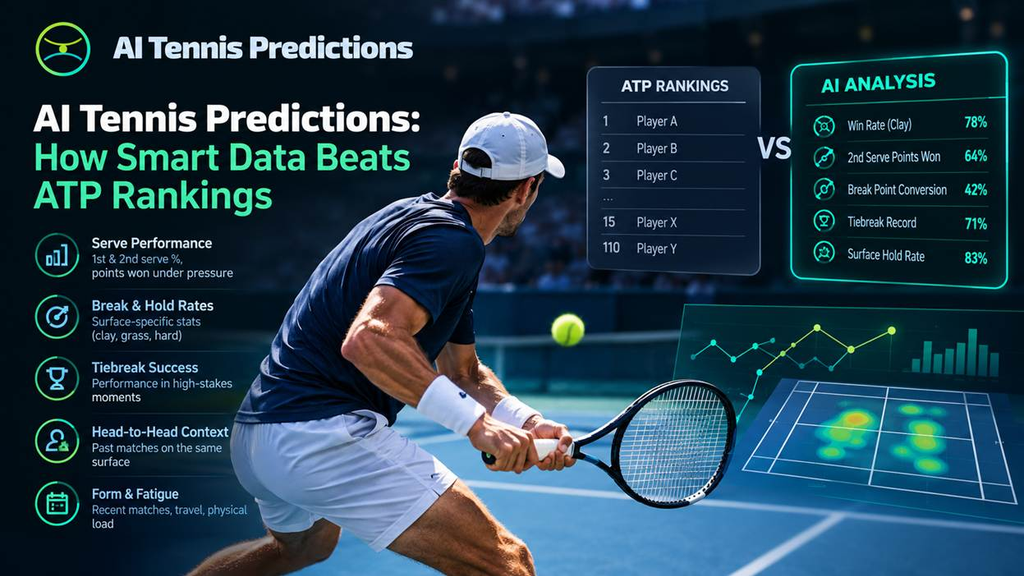
Standard world rankings tell a tidy story. They show you who won six months ago on a fast, hard court in Dubai, but they completely ignore how that same player handles heavy red clay in Madrid after a grueling three-set battle yesterday. That is where traditional analysis breaks down. By looking beyond superficial standings, modern AI tennis predictions process thousands of live data points—from first-serve percentages to second-serve points won under pressure. You stop guessing based on big names and start making decisions based on cold court facts. Here is how algorithmic modeling changes how we evaluate every WTA and ATP fixture.
Why Do Traditional Tennis Rankings Fail?
A number next to a player’s name creates a false sense of security. Bookmakers and casual fans often overtrust seeds, ignoring the specific context of the match.
Tennis is a sport of micro-variables. A fast grass court at Queen’s Club rewards a heavy serve-and-volley style, while a slow court in Rome turns the match into a physical grinding session from the baseline. If a player holding a top-20 spot lacks rally tolerance on clay, their rank means nothing against an unseeded dirt specialist. Furthermore, fatigue accumulates rapidly during back-to-back weeks of touring. When you factor in travel schedules, recent physical strain, and match duration, official rankings quickly lose their predictive strength. Data models filter out brand bias and instead evaluate the current physical form.
What Key Data Points Drive AI Tennis Predictions?
Instead of relying on gut feeling, data-driven platforms crunch numbers that human brains simply overlook during a busy tournament week. When generated properly, reliable AI tennis predictions rely on specific measurable metrics rather than reputation:
- Surface-Specific Hold and Break Rates: How well a player retains service games on grass versus clay courts.
- Second-Serve Protection: The percentage of points won on weaker second serves when under heavy pressure.
- Break-Point Conversion: A player’s ability to capitalize on rare scoring opportunities against elite servers.
- Tiebreak History: Performance during high-stakes, late-set pressure moments.
- Head-to-Head Surface Context: Previous meetings were evaluated strictly on the same court surface rather than on generic historical results.
When you combine these numbers, matchup dynamics become clear long before the first serve.
Why Is WTA Tennis So Volatile for Predictors?
Women’s matches are played in a best-of-three format across all events, including Grand Slams. This structure naturally increases scoreline variance. A single early break of serve in the first set carries far more weight than it does in a five-set men’s match, where a player has time to recover. On the WTA tour, return games dominate, leading to frequent momentum swings and broken serves. Models analyzing WTA matches focus heavily on return quality, baseline rally endurance, and recent court-speed adjustments to catch sudden upsets before the odds shift.
How Can You Apply Match Analysis to Your Strategy?
Raw data only carries value if you apply it correctly. Instead of searching exclusively for straight match winners, smart analysts explore alternative markets. For instance, when two dominant servers meet on a fast indoor court, set handicaps or total games often offer far better statistical value than picking a winner.
If you want to stay ahead of market movements and find value in upcoming fixtures, check out the latest AI tennis predictions today to elevate your match analysis. Integrating algorithmic insights with your own research provides a structured framework for every tournament.
Frequently Asked Questions
Can algorithms account for mid-match player injuries? Pre-match models evaluate historical retirement trends and recent physical workload, but sudden in-play injuries remain unpredictable.
Do models work equally well for ITF matches? Yes. Lower-tier ITF events feature rapid player turnover and limited public coverage, making data modeling even more effective at spotting hidden momentum shifts.
Evaluating tennis matches requires much more than scanning world rankings or relying on brand recognition. Every court surface, travel day, and serve percentage subtly alters the balance between two opponents. By tapping into high-level data models, you remove emotion from the equation and gain a sharp analytical perspective on every matchup across the ATP, WTA, and ITF circuits. Take your understanding of the game to the next level with our data insights—explore our AI tennis predictions now and make smarter, more confident assessments every single match day.